CV writing
What is a CV? Meaning, full form and what a CV looks like
Updated 2 November 2026 · By the AfriCV career team
CV in full stands for curriculum vitae, a Latin phrase that means “the course of (your) life”. A CV is a document that summarises your education, work experience, skills and achievements so that an employer can decide whether to invite you for an interview. In Kenya, Nigeria, Ghana, Uganda, South Africa and most of Africa, Europe and Asia, “CV” is the standard word for the document you send with a job application.
This page explains the meaning of a CV, what a CV looks like, what it should contain, how it differs from a resume and a cover letter, and when you need one. A full sample CV is included so you can see exactly how a professional CV is laid out.
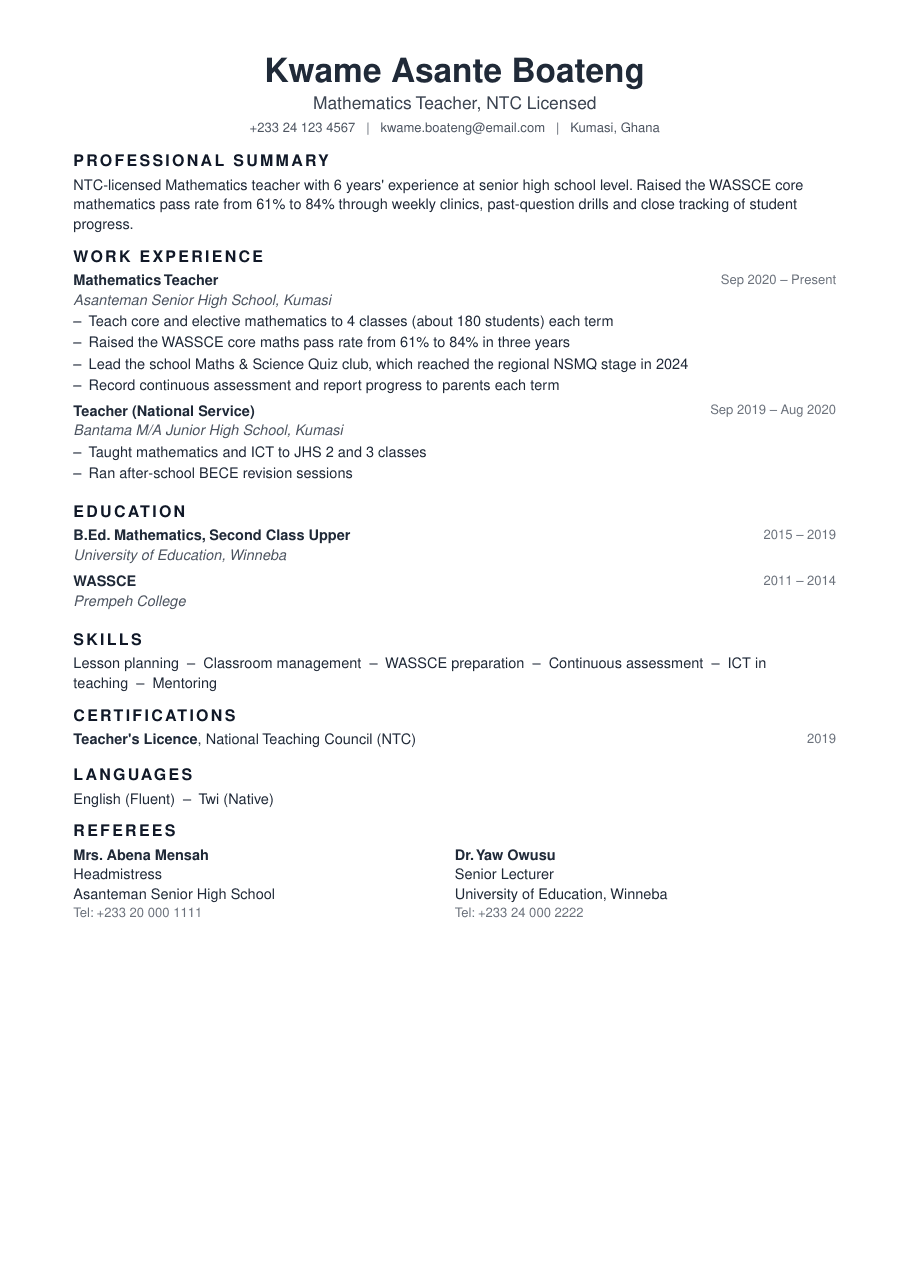
Sample CV · Minimal design · ATS-safe
Read this sample CV as text
Kwame Asante Boateng
Mathematics Teacher, NTC Licensed
Kumasi, Ghana · kwame.boateng@email.com · +233 24 123 4567
Professional Summary
NTC-licensed Mathematics teacher with 6 years' experience at senior high school level. Raised the WASSCE core mathematics pass rate from 61% to 84% through weekly clinics, past-question drills and close tracking of student progress.
Work Experience
Mathematics Teacher, Asanteman Senior High School (Sep 2020 – Present)
- Teach core and elective mathematics to 4 classes (about 180 students) each term
- Raised the WASSCE core maths pass rate from 61% to 84% in three years
- Lead the school Maths & Science Quiz club, which reached the regional NSMQ stage in 2024
- Record continuous assessment and report progress to parents each term
Teacher (National Service), Bantama M/A Junior High School (Sep 2019 – Aug 2020)
- Taught mathematics and ICT to JHS 2 and 3 classes
- Ran after-school BECE revision sessions
Education
- B.Ed. Mathematics, Second Class Upper, University of Education, Winneba (2015 – 2019)
- WASSCE, Prempeh College (2011 – 2014)
Skills
Lesson planning · Classroom management · WASSCE preparation · Continuous assessment · ICT in teaching · Mentoring
Certifications
- Teacher's Licence, National Teaching Council (NTC), 2019
CV meaning in simple words
A CV is your professional story on paper (or on screen). It answers the employer's main questions: Who are you? What have you studied? Where have you worked and what did you achieve there? What can you do? Who can confirm it? A good CV answers these questions clearly in one to two pages, so the employer can compare you with other applicants quickly.
The plural of curriculum vitae is *curricula vitae*, though most people simply say “CVs”.
What does a CV look like?
Most professional CVs follow the same basic layout, from top to bottom:
- 1
Header
Your name in large text, your professional title, phone number, email address and town.
- 2
Professional summary or objective
Three or four sentences about who you are and what you offer.
- 3
Work experience
Your jobs in reverse order (most recent first), each with title, employer, dates and achievements.
- 4
Education
Degrees, diplomas, certificates and school results.
- 5
Skills
Practical and technical skills relevant to the job.
- 6
Certifications, languages and other sections
Licences, professional memberships, languages, awards or projects.
- 7
Referees
Two or three people who can confirm your work and character.
CV vs resume: what is the difference?
In everyday use, especially in Africa, the words CV and resume are often used to mean the same thing: the document you send to apply for a job. Technically there are some differences, which matter mainly when you apply to employers in different regions.
- Length: a resume (common in the USA and Canada) is usually one page; a CV is often one to two pages, and an academic CV can be much longer.
- Detail: a CV may include more detail such as referees, publications, conferences and full education history. A resume is a short marketing summary.
- Usage: employers in Kenya, Nigeria, Ghana, South Africa, the UK and Europe usually ask for a CV. American employers usually ask for a resume.
- Academic CVs: for lecturing, research and scholarships, a CV lists publications, research grants, teaching and conferences in detail.
Make yours in 10 minutes
Design your CV free on any phone. Choose from 50+ designs, see a live ATS score, and let AI write it from a job link. Download from KES 20 / ₦200 / GH₵2 / R3.
Create my CVCV vs cover letter vs application letter
A CV summarises your whole career. A cover letter (or application letter) is a one-page letter written for one specific job. It explains why you want that job and how your experience matches it, and it points the reader to your CV. Many employers ask for both. The CV proves your background; the letter makes your case for this particular role.
When do you need a CV?
- Applying for jobs, whether online, by email or in person.
- Applying for attachment, internships and graduate trainee programmes.
- Scholarship, fellowship and university admission applications.
- Registering with recruitment agencies.
- Tenders and consultancy bids, where key staff CVs are required.
- Volunteering programmes and some government positions.
What should not be on a CV?
- Your ID or passport number, unless specifically requested.
- Date of birth, marital status, religion or tribe.
- A photo, unless the employer asks for one.
- Salary history (discuss pay at interview stage).
- Reasons for leaving each job.
- Anything untrue. Employers often verify certificates and references.
Types of CV
Chronological CV
The most common type: jobs listed from most recent to oldest. Best for people with steady work history in one field.
Skills-based (functional) CV
Organised around skills rather than jobs. Occasionally used by career changers or people with gaps, though many recruiters prefer chronological.
Combination CV
A skills or achievements section at the top, followed by a chronological history. Good for career changers and senior professionals.
Academic CV
Used for teaching, research and scholarships. Includes publications, research projects, grants, conferences and teaching experience, and is often longer than two pages.
Graduate or student CV
Puts education, attachment, projects and activities first, usually on one page.
Walkthrough: the sample CV on this page
The teacher's CV above shows all the standard parts of a CV working together. The header gives the name, title and contacts. The summary tells the reader in two sentences that this is a licensed mathematics teacher with a strong results record. Work experience lists two schools with achievements (a better WASSCE pass rate and a quiz team that reached the regional stage), and education shows the degree and school certificate. The licence, languages and referees close the CV. Every section answers a question the employer would otherwise have to ask.
How to make your own CV
The easiest way is to use an online CV builder. Fill in each section, choose a design and download a PDF. With our builder, creating and previewing is free; you can start from a career sample (teacher, nurse, driver, accountant and many more) or let AI write a first draft, and the live ATS score shows you how strong your CV is before you send it. For a step-by-step walkthrough, read our guide on how to write a CV for a job.
Frequently asked questions
What is CV in full?
Curriculum vitae, Latin for “course of life”.
Is a CV the same as a resume?
In most of Africa they are used interchangeably. Technically, a resume is shorter and a CV can be more detailed.
How many pages should a CV be?
One to two pages for most job seekers; academic CVs can be longer.
Does a CV need a photo?
No, unless the employer asks for one.
Ready to apply?
Start from a ready-made sample for your career, check your ATS score as you type, and download a clean PDF when you're happy. Pay with M-Pesa, mobile money or card.
Start my CV