CV writing
How to write a CV for a job: a step-by-step guide with a sample
Updated 2 November 2026 · By the AfriCV career team
Your CV has one purpose: to get you an interview. It does not need to tell your whole life story. It needs to prove, quickly and clearly, that you can do the job in the advert. Recruiters in Kenya, Nigeria, Ghana and South Africa often receive hundreds of CVs for one vacancy, and most give each CV well under a minute on the first read. The way you write and organise your CV decides whether you make the shortlist.
This guide walks you through writing a CV for a job from a blank page to a finished PDF: what to put in each section, how to write achievements instead of duties, how to tailor your CV to a job advert, and how to make sure applicant tracking systems can read it. You will also see a complete sample CV you can copy.
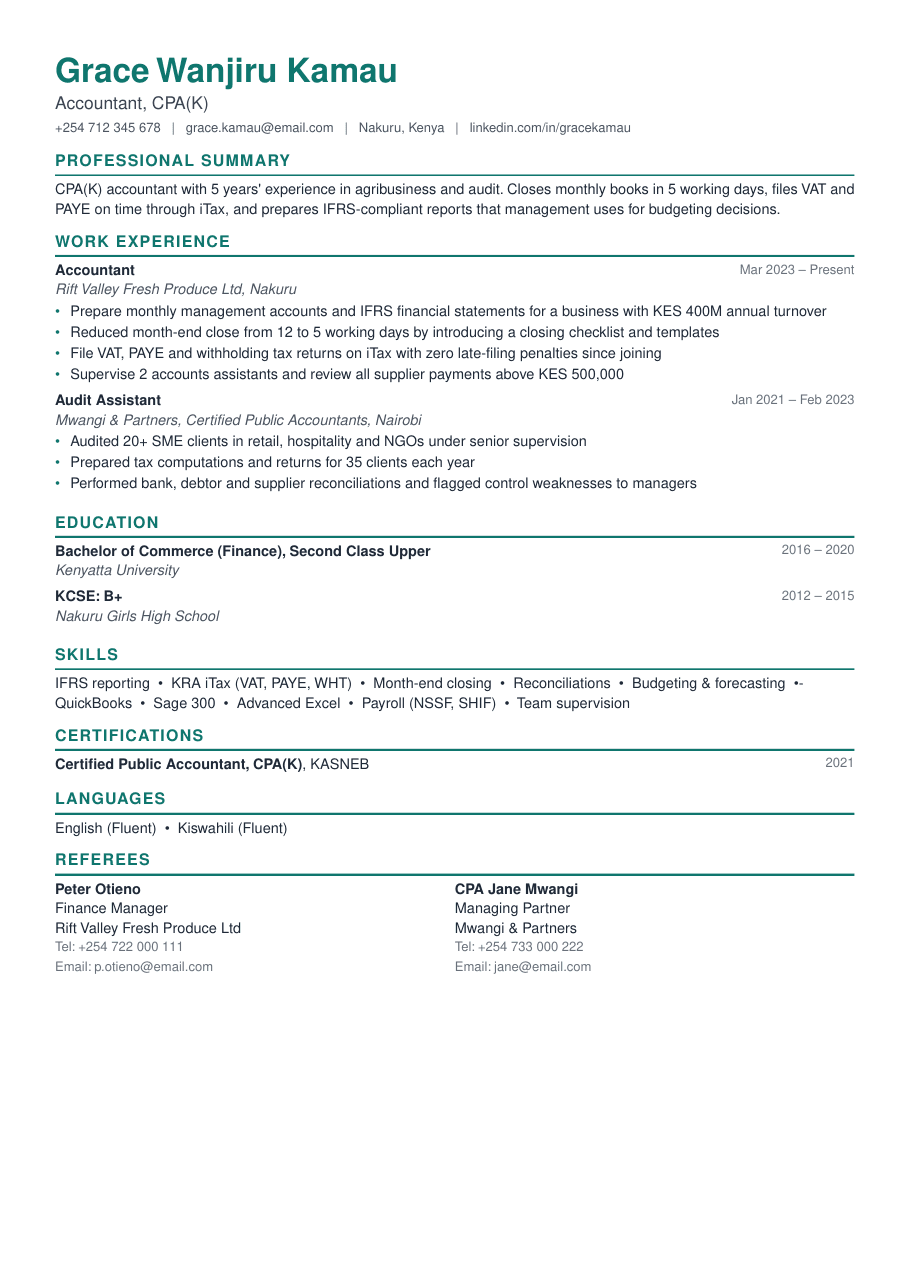
Sample CV · Classic design · ATS-safe
Read this sample CV as text
Grace Wanjiru Kamau
Accountant, CPA(K)
Nakuru, Kenya · grace.kamau@email.com · +254 712 345 678
Professional Summary
CPA(K) accountant with 5 years' experience in agribusiness and audit. Closes monthly books in 5 working days, files VAT and PAYE on time through iTax, and prepares IFRS-compliant reports that management uses for budgeting decisions.
Work Experience
Accountant, Rift Valley Fresh Produce Ltd (Mar 2023 – Present)
- Prepare monthly management accounts and IFRS financial statements for a business with KES 400M annual turnover
- Reduced month-end close from 12 to 5 working days by introducing a closing checklist and templates
- File VAT, PAYE and withholding tax returns on iTax with zero late-filing penalties since joining
- Supervise 2 accounts assistants and review all supplier payments above KES 500,000
Audit Assistant, Mwangi & Partners, Certified Public Accountants (Jan 2021 – Feb 2023)
- Audited 20+ SME clients in retail, hospitality and NGOs under senior supervision
- Prepared tax computations and returns for 35 clients each year
- Performed bank, debtor and supplier reconciliations and flagged control weaknesses to managers
Education
- Bachelor of Commerce (Finance), Second Class Upper, Kenyatta University (2016 – 2020)
- KCSE: B+, Nakuru Girls High School (2012 – 2015)
Skills
IFRS reporting · KRA iTax (VAT, PAYE, WHT) · Month-end closing · Reconciliations · Budgeting & forecasting · QuickBooks · Sage 300 · Advanced Excel · Payroll (NSSF, SHIF) · Team supervision
Certifications
- Certified Public Accountant, CPA(K), KASNEB, 2021
Before you write: read the job advert carefully
The best CVs are written for a specific job. Before you type anything, read the advert two or three times and highlight four things: the job title, the must-have qualifications (degree, licence, years of experience), the key skills and tools (for example QuickBooks, IV cannulation, AutoCAD, customer service), and the main responsibilities. These highlighted words are your checklist. A strong CV shows evidence for each one.
If the advert is vague, look at two or three similar adverts from other employers. The common requirements tell you what matters for that kind of role.
Step 1: Choose a clear CV format
For almost every job, use the reverse-chronological format: your most recent job first, then the one before it, and so on. Recruiters expect it and applicant tracking systems read it reliably. Use a clean, single-column design with standard headings, a readable font at 10–12 pt and margins of about 2 cm.
Keep your CV to one page if you have less than five years of experience and two pages if you have more. Senior professionals, doctors, academics and development-sector specialists sometimes need three, but only if every line is relevant.
Step 2: Write your contact details
Leave out your ID or passport number, date of birth, marital status, religion, tribe and a photo, unless the advert specifically asks for them.
- Full name (as on your certificates), large and clear at the top.
- A professional title that matches the job, such as “Customer Service Representative”.
- One phone number with the country code (+254, +234, +233, +27).
- A professional email address. Create a new one if your current email is a nickname.
- Town and country. A full postal address is not needed.
- LinkedIn or a portfolio link if it is up to date.
Make yours in 10 minutes
Design your CV free on any phone. Choose from 50+ designs, see a live ATS score, and let AI write it from a job link. Download from KES 20 / ₦200 / GH₵2 / R3.
Create my CVStep 3: Write a professional summary that matches the job
The summary sits right under your name and is the first thing recruiters read. In three or four sentences, say who you are, how much experience you have, what you are best at and what you can bring to this employer. Use words from the advert where they are true.
Weak: “Hardworking and result-oriented individual seeking a challenging position in a reputable organisation.” (This could describe anyone.)
Strong: “CPA(K) accountant with 5 years in agribusiness and audit. Closes monthly books in 5 working days, files VAT and PAYE on time through iTax, and prepares IFRS reports that management uses for budgeting.” (This is specific and believable.)
Step 4: List your work experience with achievements
For each job write the title, employer, town and dates (month and year). Then add three to six bullet points. The secret of a strong CV is to write achievements, not duties. Duties describe what anyone in that role is supposed to do. Achievements show what you actually did and how well you did it.
A simple formula works for every industry: action verb + what you did + result (with a number if possible).
- Duty: “Responsible for customer complaints.” → Achievement: “Resolved 70+ customer requests daily with a 92% satisfaction score.”
- Duty: “Teaching mathematics.” → Achievement: “Raised the WASSCE core maths pass rate from 61% to 84% in three years.”
- Duty: “In charge of stores.” → Achievement: “Cut stock losses by 15% by introducing weekly cycle counts.”
- Duty: “Driving company vehicles.” → Achievement: “Drove 28-tonne trucks on the Nairobi–Mombasa corridor with zero accidents in five years.”
Step 5: Add education, skills and certifications
Education
List your highest qualification first with the institution and year. Add your class of degree or grade if it is strong. Recent graduates should add secondary school results such as KCSE, WASSCE, NECO or NSC (Matric). After a few years of work, you can drop them.
Skills
List 8–14 skills that match the advert: tools, systems, methods and a few soft skills. “Microsoft Excel (pivot tables)” is more convincing than “computer literate”. Do not use skill bars or star ratings; they cannot be measured and some software cannot read them.
Certifications and licences
Professional licences matter in many African job markets: CPA, ACCA, NMCN, KMPDC, TSC, COREN, PSIRA, driving licence classes and so on. List each with the issuing body and year.
Step 6: Add referees
Most employers in Kenya, Nigeria, Ghana and Uganda still expect two or three referees on a CV. Choose people who know your work well, such as a current or former supervisor, a lecturer, or a client, and ask their permission first. Give their name, position, organisation and phone number. If you prefer not to share contacts yet, write “Referees available on request”, but be ready to provide them quickly.
Step 7: Tailor, check and send
- 1
Tailor it
Adjust your title, summary and skills for each job, and move your most relevant achievements to the top of each role. Our AI can do this in about a minute when you paste the advert.
- 2
Check the ATS score
Our editor scores your CV live as you type: contact details, summary length, numbers in your bullets, action verbs, layout and keyword match with the advert.
- 3
Proofread
Read it aloud, check every date and phone number, and ask someone else to read it. One spelling mistake can cost you the interview.
- 4
Save and name the file
Download a PDF named Firstname_Lastname_CV.pdf. Send it with a short, specific cover letter or email.
Common CV mistakes to avoid
- Sending the same CV to every employer.
- Using a nickname email or an old phone number.
- Writing long paragraphs instead of short bullets.
- Leaving unexplained gaps. Add a short line such as “Career break: further studies, 2023”.
- Exaggerating or inventing qualifications. Background checks are common and lying can get an offer withdrawn.
Frequently asked questions
How long should a CV for a job be?
One page for less than five years of experience, two pages for most experienced professionals.
What should I put first on my CV?
Your name and contacts, then a short professional summary, then work experience. Students and graduates can put education before experience.
Should I write a different CV for every job?
You should at least tailor the title, summary and skills to each advert. It greatly improves your chances.
Do I need a cover letter with my CV?
If the advert asks for one, yes. Even when it doesn't, a short tailored letter or email helps.
Can I write my CV on my phone?
Yes. Our builder works in any phone browser and saves as you type.
Ready to apply?
Start from a ready-made sample for your career, check your ATS score as you type, and download a clean PDF when you're happy. Pay with M-Pesa, mobile money or card.
Start my CV